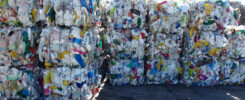
If you trade plastic scrap in Dubai, a rule that took effect in Europe now sits on your supply map. The EU plastic waste export ban is in force. It started on 21 November 2026. From that date, the European Union prohibits exports of plastic waste to non-OECD countries, and the UAE is not an OECD member.
This article explains what has closed, what has not, and what a Dubai trader should check before contracting European material. It is general information, not legal advice. For a specific shipment, speak to your authority and customs adviser.
What the EU plastic waste export ban changed on 21 November 2026
The rule comes from the revised Waste Shipment Regulation, Regulation (EU) 2024/1157, which entered into force on 20 May 2024. The Commission has applied the plastic-export provisions in stages.
Since 21 May 2026, any export of plastic waste from the EU has needed the prior notification and consent procedure. That includes clean, non-hazardous plastic destined for recycling, listed as B3011. The competent authorities of dispatch, destination and any transit have to agree before the shipment leaves.
Then, on 21 November 2026, a further step took effect. The Commission confirmed that exports of plastic waste from the EU to non-OECD countries are now prohibited. The prohibition covers all plastic waste, including that clean B3011 material. The ban runs at least until 21 May 2029.
After that date, a non-OECD country may apply to the Commission if it wants to receive EU plastic waste. It must show that it can manage the material in an environmentally sound manner. Any such request can cover only B3011 material. Until a country appears on that future list, the destination stays closed.
What the EU plastic waste export ban shows in 2025 volumes
The Commission says the EU generates around 40 million tonnes of plastic waste a year and exports between 1 and 1.5 million tonnes. In 2025, around half of those exports went to OECD countries and half to non-OECD countries. The main destinations were Türkiye (510,000 tonnes), Malaysia (276,000 tonnes), Indonesia (215,000 tonnes), Vietnam (137,000 tonnes) and the United Kingdom (108,000 tonnes). The Commission did not name the UAE in that list, so this article does not invent a Dubai volume.
Why the EU plastic waste export ban closes Europe as a waste-feedstock source
The dividing line is OECD membership, not the quality of a recycling plant at the receiving end. The OECD currently lists 38 members, including Türkiye, the United Kingdom, and EU countries such as Germany, Hungary and Poland. The United Arab Emirates, India, Malaysia and Hong Kong are not OECD members.
As a result, a European seller may no longer export plastic waste from the EU to Dubai, or to India, Malaysia or Hong Kong, until at least 21 May 2029. That is true even for well-sorted, single-polymer bales that a licensed recycler could process.
If your business used to buy European plastic waste, that route is now closed at the European end. You cannot fix it by routing the same waste through another non-OECD port.
OECD routes, audits and the later non-OECD list
Exports of plastic waste from the EU to OECD countries remain possible, but under greater scrutiny and prior notification and consent. The Commission is monitoring those flows. On 18 September 2026 it published an assessment of exports to Türkiye, the largest 2025 destination. From 21 May 2027, EU exporters of waste to countries outside the EU will also need an independent audit of the destination facility, unless an international agreement says otherwise. Those OECD rules matter to European sellers. They do not reopen the UAE for EU plastic waste.
A separate Commission list of non-OECD countries authorised to receive certain other non-hazardous wastes is due around the end of 2026, with a wider export restriction from 21 May 2027. That list does not lift the plastic-waste ban. Plastics remain on their own, later timetable.
What Dubai traders can still buy and sell
The ban applies to plastic waste leaving the EU. It does not, by itself, stop every plastics trade involving Europe, and it does not freeze the UAE’s own collection and export markets.
UAE and regional material. You can still buy and sell plastic scrap generated in the UAE and, where the local rules allow, in the wider region. Trading and export in Dubai remain licensed activities. Our buyers’ guide and price guide cover the local market. Those lots still need the correct permits and documents.
Other non-EU origins. Scrap that never left the EU as waste — for example material collected in the GCC, Africa or other non-EU countries — is not moved by this particular EU export rule. Each origin and destination still has its own import and export controls, including Basel procedures where they apply.
Non-waste goods and material already in the UAE
Goods that are not waste. Off-grade virgin granules and some processed materials in primary form are often classified under headings 3901 to 3914, not heading 3915 (waste, parings and scrap of plastics). The Commission’s Access2Markets guidance says that if waste, parings and scrap have been transformed into a primary form — granules, flakes, lumps or powder — they should be classified under the polymer heading. Regrind and offcuts, including PMMA regrind, may be products or scrap depending on the facts of the consignment. Customs classification and waste status are not automatically the same question. Only the competent authorities can confirm a specific lot. See our companion guide on off-grade virgin granules and HS codes. Do not treat a 3901–3914 heading as a route around the ban.
Material already in the UAE. The EU rule controls exports from the Union. If a consignment of European plastic waste was already lawfully in the UAE before 21 November 2026, any onward export is a UAE export and still needs the permits and documents that apply to plastic scrap. It does not create a new right to buy fresh EU plastic waste.
In short, Dubai remains a hub for local and regional scrap, and for non-waste polymer products, but it is not a back door for new EU plastic-waste exports.
A practical checklist for Dubai traders
- When a European supplier offers material, ask whether it is plastic waste or a non-waste product, and get that in writing.
- If it is plastic waste, do not book it from the EU to the UAE, India, Malaysia, Hong Kong or any other non-OECD destination.
- If the seller claims the goods are off-grade virgin granules or another primary form, confirm the HS heading and waste status with advice before you pay a deposit.
- For UAE-origin scrap, keep using licensed buyers and the export documents your authority requires.
- Do not invent a transit story to move EU plastic waste through Jebel Ali to a non-OECD buyer.
- Watch the Commission’s later list of authorised countries for other wastes, but do not assume it will cover plastics before 21 May 2029.
How ALTARA can help
AL TARA GLOBAL RESOURCES L.L.C-FZ is a Dubai (Meydan Free Zone) trader of plastic scrap, regrind and off-grade granules, with group operations in India, Hong Kong and Hungary.
We buy documented commercial lots, and we work within the rules that now apply. We do not ask European sellers to ship plastic waste to destinations the ban has closed.
If you have a UAE or regional lot, or you need to source lawful material, contact us with the grade, quantity and photos. Email cs@altarauae.com or WhatsApp +971 55 937 5839.
Frequently asked questions
Can a Dubai trader still import plastic waste from Germany, Poland or Hungary?
Not if the consignment is plastic waste leaving the EU. The UAE is not an OECD member, so the EU plastic waste export ban applies from 21 November 2026 until at least 21 May 2029.
Does the ban cover clean, well-sorted bales?
Yes. The Commission is clear that the prohibition includes clean, non-hazardous plastic waste destined for recycling (B3011).
Can I still buy off-grade virgin granules from Europe?
Possibly, if the goods are not waste and the classification is correct. That is a facts-and-documents question, not an automatic exception. Get advice before you contract.
Will the ban raise plastic scrap prices in Dubai?
This article does not forecast prices. The Commission has published EU export volumes and destinations, not a Dubai price effect. Local prices still depend on grade, cleanliness, demand and freight.
General information only, not legal advice. Check the current official texts, and obtain professional advice, before you contract or ship material.
Sources
Checked on 26 November 2026.
- European Commission, “EU bans plastic waste exports to non-OECD countries from November 21,” 20 November 2026: https://environment.ec.europa.eu/news/eu-bans-plastic-waste-exports-non-oecd-countries-2026-11-20_en
- European Commission, “Plastic waste shipments”: https://environment.ec.europa.eu/topics/waste-and-recycling/waste-shipments/plastic-waste-shipments_en
- Regulation (EU) 2024/1157: https://eur-lex.europa.eu/eli/reg/2024/1157/oj/eng
- European Commission, assessment of plastic waste exports to OECD countries, 18 September 2026: https://environment.ec.europa.eu/publications/assessment-sustainability-plastic-waste-exports-oecd-countries_en
- OECD, “Members and partners”: https://www.oecd.org/en/about/members-partners.html
- European Commission, Access2Markets, “Classifying plastics”: https://trade.ec.europa.eu/access-to-markets/en/content/classifying-plastics