The UAE blog already has several posts on LDPE agglomerate and scrap. It has not, until now, had a dedicated guide to LLDPE film scrap and LLDPE granules. The two resins are related, and film producers often blend them in film. However, they are not identical, so a buyer who treats them as the same thing can end up with the wrong melt behaviour on the line.
This is a practical buyer’s guide for commercial lots in the UAE. It does not publish prices. Grades and cleanliness move the value, and we will not invent a number.
Why LLDPE film scrap is not the same as LDPE
LLDPE is linear low-density polyethylene. Producers make it by copolymerising ethylene with a short alpha-olefin comonomer, commonly butene, hexene or octene. The chains are largely linear, with short branches from that comonomer. However, producers make LDPE with a different process that introduces both short and long-chain branching.
Because of that structural difference, film producers often choose LLDPE for toughness, puncture resistance and downgauging, and LDPE for melt strength, bubble stability and some shrink or clarity jobs. In addition, blown-film recipes frequently blend the two. A bale of “PE film” from a factory or a warehouse can therefore be LLDPE, LDPE, or a mix. The appearance of the film will not always tell you which.
However, density ranges overlap, so a float-or-sink test will not separate them reliably. A LyondellBasell technical guide on polyolefin film extrusion gives LLDPE resin densities from 0.900 to 0.939 g/cm³ and LDPE from 0.916 to 0.925 g/cm³. Those are manufacturer guide ranges, not a laboratory result for your lot. Melt index also describes flow, not identity. The same guide notes that laboratories typically measure melt index for polyethylene at 190°C under a 2,160 g load, and that many LLDPE film resins sit in a low melt-index band.
How to tell LLDPE film scrap from LDPE in the lab
Therefore, if you need to distinguish the resins in an unknown film, source records come first. Where records are missing, a laboratory can use differential scanning calorimetry (DSC). Published work on LDPE/LLDPE blends describes a relatively narrow melting range for typical film-grade LDPE, and a broader, often two-peak melting pattern for LLDPE. FTIR can confirm polyethylene and, in some studies, help identify the comonomer type, but it does not always separate the two resins on its own. Those tests cost money. Still, they are cheaper than running a production trial on the wrong blend.
On packaging, converters often mark LLDPE film with resin identification code 4, the same family code that Commission Decision 97/129/EC uses for LDPE. The code is only an aid. In particular, it does not prove the film is a single polymer, unprinted, or suitable for your process.
How sellers offer LLDPE film scrap and granules
In practice, buyers in the UAE usually see LLDPE in three commercial forms.
Film scrap, often in bales or compacted packs. This is the starting point for many lots: stretch wrap, stretch hood, liners, shrink-related trimmings, bag film or agricultural film. The useful questions are whether the film is natural or coloured, printed or plain, dry, and relatively free of paper, tape, metal and other polymers. For example, stretch film can carry tackifier. Printed shopping bags carry ink. Agricultural film can also carry soil and UV stabiliser. Those are different products, even if a WhatsApp message describes each as LLDPE film.
Regrind and granules from LLDPE film scrap
Regrind. If the seller has shredded the film, you are buying a bulk density and a particle size as well as a polymer. Moisture, fines and residual contamination should be in the specification.
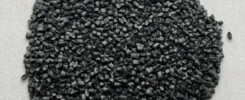
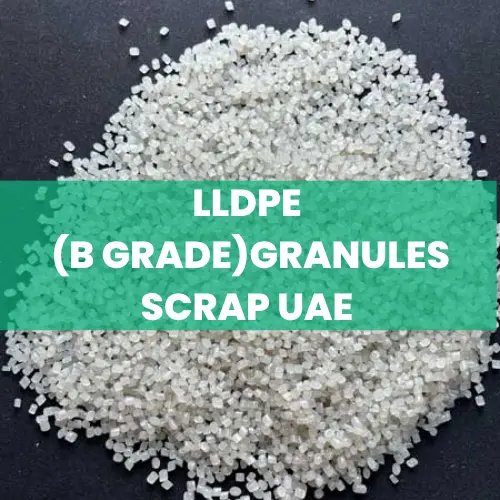
Granules. Once a recycler has melted and pelletised the scrap, sellers offer it as granules, sometimes in A, B and C grades. AL TARA lists LLDPE granules, A grade, B grade and C grade on the product pages, with prices on request. However, grade letters are a supplier’s quality band, not an international standard. Therefore, always read the actual specification that comes with the lot: colour, visible contamination, and any melt-flow result.
Cabinet Resolution No. (116) of 2023 includes plastic solid waste of PE — HDPE, LDPE and LLDPE — under headings 3915.10 and 3915.90 in its tables of recyclable materials. If you are buying or exporting the goods as scrap, treat them as a regulated recyclable material, not as an ordinary consumer cargo. If a recycler has then converted the lot into primary-form granules, the HS heading may change. That is a classification question, covered in our guide on off-grade virgin granules and plastic scrap.
What a buyer should specify for LLDPE film scrap
A short, clear specification prevents most disputes. Before you pay a deposit, therefore, agree at least the following:
- Polymer and blend. Is the lot sold as LLDPE, as LDPE, or as a PE film mix? If the seller knows the LLDPE/LDPE ratio, write it down.
- Form. Bales of film, regrind or granules, and the packing (jumbo bags, pallets, bale weight).
- Colour and print. Natural, white, mixed colour, or printed. Ink and pigment change both process and price.
- Application history. Stretch film, liners, bag factory trim or agricultural film, if known.
- Contamination and moisture. Other polymers, paper, metal, grit, oil and water should have a stated limit, even if it is “none visible.”
- Melt flow and density, where a laboratory result exists. Treat a single number as a lot result, not as a grade promise for the next container.
- Photos and a sample. Ask for loading photos and, for a first supplier, a sample you can test or trial.
- Quantity and continuity. One truck and a monthly programme are different offers.
Pricing context and checks for export buyers
For pricing context on other plastics in the UAE, see our plastic scrap price guide. However, it does not quote an LLDPE number, and this article will not invent one. Ask for a price against the specification above.
If you are buying to export, also confirm the destination’s import rules. Malaysia, for example, has its own approval process for plastic-waste imports. The EU plastic waste export ban does not stop UAE-origin LLDPE leaving Dubai, but it does affect European-origin waste that a seller might try to route through the UAE.
How ALTARA can help
AL TARA GLOBAL RESOURCES L.L.C-FZ is a Dubai (Meydan Free Zone) trader of plastic scrap, regrind and off-grade granules, including LLDPE in granule form, with group operations in India, Hong Kong and Hungary.
If you want to buy or sell this material or granules, contact us with the form, colour, quantity and photos. Email cs@altarauae.com or WhatsApp +971 55 937 5839. We will discuss the lot against a specification. We will not, however, guess a grade from a single picture.
Frequently asked questions
Is LLDPE film scrap the same as LDPE film scrap?
No. They are both polyethylenes in a similar density band, and processors often blend them. Still, the chain structure and processing behaviour differ. Ask which resin, or which blend, the seller is offering.
Can I identify LLDPE with a float test?
Not reliably. The density ranges overlap with LDPE. Instead, use source documents first, then laboratory tests such as melt flow and DSC if you need certainty.
What does resin code 4 tell me?
Only that the article is in the LDPE/LLDPE family. It does not tell you the blend, the print level or whether a particular recycler will accept it.
Do you publish an LLDPE price per kilogram?
No. Prices are on request, against a specified lot. A natural stretch-film grade and a mixed printed film are not the same material.
General information only, not a laboratory report or a sales specification. Trial the material before you commit a production run.
Sources
Checked on 26 November 2026.
- LyondellBasell, “A Guide to Polyolefin Film Extrusion” (density and melt-index guidance for LLDPE and LDPE film resins): https://www.lyondellbasell.com/globalassets/lyb/our-solutions/products/documents/polymers-technical-literature/A_Guide_to_Polyolefin_Film_Extrusion.pdf
- Commission Decision 97/129/EC, identification system for packaging materials (resin identification number 4 for LDPE): https://eur-lex.europa.eu/legal-content/EN/TXT/?uri=CELEX:31997D0129
- Prasad, A., “A quantitative analysis of low density polyethylene and linear low density polyethylene blends by differential scanning calorimetry and Fourier transform infrared spectroscopy methods,” Polymer Engineering & Science, 1998: https://doi.org/10.1002/pen.10342
- UAE Legislation, Cabinet Resolution No. (116) of 2023: https://uaelegislation.gov.ae/en/legislations/2342
- AL TARA product pages for LLDPE granules, A, B and C grades: https://altarauae.com/product/plastic/lldpe-granules-scrap-a-grade-uae/