PET bottle scrap is the polymer grade that most consistently shows up in local UAE searches. People look for it in the UAE and in Dubai, for suppliers, and for how to recycle bottles. Clear drinks bottles are easy to recognise. In addition, collectors gather them in volume, and they have an established route into flakes and recycled PET (rPET).
This guide explains how traders describe and trade that scrap. It covers forms, colour splits, contamination, and how they sell or export material from the UAE. It does not invent price lists. If you need price context, use our UAE plastic scrap price guide. For international flake markets, see our article on rPET flake prices in Asia and Europe.
What counts as PET bottle scrap
PET is polyethylene terephthalate, marked with resin identification code #1 (PET or PETE) under ASTM D7611 [1]. The bottle-scrap stream is mainly post-consumer drinks bottles and jars with a screw neck. Closures and labels often remain on the bottles when sellers first bale them.
However, it is not the same as every item made of PET. Thermoformed trays, clam-shells, cups and some opaque or coloured containers behave differently in a washing and pelletising line. Used oil bottles and pesticide containers do not belong in a bottle bale [2]. Similarly, other packaging that held hazardous products does not belong there. If you are dropping off a few household bottles, use the public options in where to sell plastic scrap in Dubai and the UAE. Instead, this article is about commercial lots.
The forms it is sold in
Buyers pay for a polymer and for a form. The usual forms in this trade are [3]:
-
- Baled bottles. Whole, emptied bottles compacted and tied, usually after a first colour sort.
-
- Dirty or unwashed flakes. Shredded bottles, often still with labels, glue and residues.
-
- Washed flakes (including hot-washed flakes). Cleaned to a buyer’s specification, often with most caps and labels removed. This is a typical rPET feedstock.
-
- Granules or pellets. Melted and pelletised material. If a plant has transformed single-polymer material into a primary form, the heading may differ from scrap. Confirm it with a licensed customs broker. See our guide to HS code 3915 and Basel codes.
A lot described only as “PET scrap” is incomplete. Therefore, always state the form, the colour and the wash status.

Colour and how it affects the lot
Colour is one of the first things a PET buyer will ask about, because it limits the flake’s end uses.
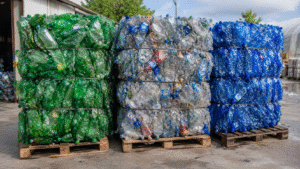
Sellers commonly offer lots as clear or natural, often grouped with transparent light blue, transparent green or mixed colour. Where volume exists, they also offer narrower colours such as brown.
A recognised industry starting point is the ISRI specification for PET bottles (no thermoforms). It describes whole post-consumer #1 PET bottles or jars that are clear, transparent green, or transparent light blue. They should be empty of contents or free-flowing liquids. Caps, lids, rings and labels may remain. Other colours, including fluorescent and opaque PET, need the buyer’s allowance [2].
ISRI is a US industry specification. However, UAE buyers and export customers may use it as a reference, or a tighter factory specification of their own. Agree the colour mix in writing. Otherwise, buyers will not automatically accept a mixed bale as a clear grade.
Bale grades and contamination
ISRI grades PET bottle bales by the PET bottle fraction by weight, including caps and labels still attached to PET containers [2]:
| Grade | Total PET bottle fraction by weight |
|---|---|
| Grade A | 94% or above |
| Grade B | 83–93% |
| Grade C | 73–82% |
Total contaminants should not exceed the balance implied by those bands. Some other packaging is only tolerable at low levels, generally not more than 2% by weight of each. For example, this covers certain HDPE, LDPE and PP rigids, clear PET thermoforms, aluminium cans, loose paper or cardboard, and liquid residues. Materials treated as not allowed, and which may lead to rejection, include PVC in any form, PS, PETG, PLA, #7 plastics, film and bags, and foam [2]. They also include containers that held hazardous products (including motor oil and pesticides), metal, wood, glass, batteries, biomedical waste, and dirt, stones, oils and grease.
Bales should be intact, reasonably dry and free of free-flowing liquid. ISRI also sets a minimum compressed density (10 pounds per cubic foot) and calls for non-rusting ties. In addition, bales must keep their integrity through loading and storage [2]. However, individual contracts may set different packing rules.
In the yard, PVC is a serious problem in PET, because a small amount can damage a recycling stream. Keep oil bottles and chemical containers out. Drain and, where practical, rinse. Also, keep thermoforms and film separate unless the buyer has said otherwise. Dubai Municipality’s waste-plastic trading guidelines also stress sorting by polymer, inspection and sampling. In particular, they state that traders should not accept plastic wastes contaminated with hazardous substances, such as pesticides [4].
How PET bottle scrap is sold and exported
Domestic sales in the UAE are usually a B2B contract. The contract covers specification, photos or a sample, quantity, packing, delivery term and payment. Those buyers and suppliers include recyclers who wash and flake bottles, as well as traders who place material with industrial buyers. AL TARA is a trader, not a washer.
For export, several layers can apply. Therefore, check them for the specific shipment rather than assume them:
-
- Classification. PET waste, parings and scrap commonly falls under HS 3915.90 (“of other plastics”), not 3915.10, which is for polymers of ethylene [5]. However, a broker may assess flakes or granules differently if the goods count as a primary form.
-
- Basel Convention. Authorities may treat clean, almost uncontaminated single-polymer PET destined for recycling under the B3011 entry. In contrast, mixed or contaminated material can fall under other listings. See our HS and Basel guide [6].
-
- UAE export rules for recyclable materials. Cabinet Resolution No. (116) of 2023 sets further rules for UAE exports of recyclable materials [7]. Among other things, it requires establishments to separate non-hazardous recyclable plastics listed in its tables by type. They must then clean and cut them in the UAE to the physical properties in Table No. (3) (“conversion into granules/flakes” for plastic solid waste). The file also needs laboratory examinations and an official letter from the competent authority in the importing state. The application goes through the Ministry’s recyclable-materials export service [7]. For this reason, confirm how that table applies to a particular form, for example a bottle bale versus washed flake. Check this with the Ministry of Climate Change and Environment and the competent local authority. It is not something to guess from a blog post.
-
- Licences and local permits. Trading and exporting both need licences and local permits. See plastic waste trading licences and export permits.
Price: what actually moves the number
We do not publish invented AED-per-kilogram figures here. Prices move with colour, contamination, form, freight and the destination market. In particular, clear usually commands more interest than mixed colour, and a bale differs from a washed flake. Start with the UAE plastic scrap price article and the rPET price article. When you ask for a quote, send the form, colour split, estimated contamination and packing. Also send the quantity, photos of the actual lot, and the delivery point.
How ALTARA works with PET
AL TARA GLOBAL RESOURCES L.L.C-FZ has its office in Dubai’s Meydan Free Zone. It trades PET among other recyclable plastics, including PET bottle flakes. We source from recyclers and suppliers in the UAE and supply industrial buyers. The group also has operations in India, Hong Kong and Hungary. If you have commercial PET bottles, bales or flakes, contact us with the specification and photos. However, we do not buy household bags of bottles.
Frequently asked questions
What is PET bottle scrap? Post-consumer (and sometimes commercial) #1 PET bottles and jars, sold as bales, flakes or further-processed forms — not PET thermoforms, and not containers that held hazardous products [2].
Do caps and labels have to be removed? Not always at the bale stage; ISRI allows closures and labels to remain [2]. Washed-flake buyers often require most of that material to have been removed. Follow the agreed specification.
What HS code is used for PET bottle scrap? Commonly 3915.90. Confirm the heading for your form and destination with a licensed customs broker [5].
Can I export whole PET bales from the UAE? Export is regulated. Cabinet Resolution 116/2023 includes a requirement to convert plastic solid waste into granules or flakes [7]. Confirm how that applies to your form before you contract to ship bales.
Where can residents recycle PET bottles in Dubai? Municipal Smart Sustainability Oasis centres, Averda drop-off and programmes such as Recapp. See where to sell plastic scrap.
Related reading
See also regrind versus flakes and granules and plastic scrap buyers in the UAE. Email cs@altarauae.com, WhatsApp +971 55 937 5839, or use the contact page.
General information only, not legal advice. Confirm specifications, classification and export rules with the buyer, a customs broker and the authorities.